COACH FORUM: Assessments: FTP Bike and Run questions

Before we get the WHY I've called out some guidance for application of the tests.
- Ramp guidance and protocol including how to input new "ftp" Here
- How to calculate your 20 min FTP Test: multiply your avg power for the 20 mins by .95. Use your average HR for the entire 20 mins as your Threshold HR
- Run test: The last 10 mins of the run is both your Threshold pace and Threshold HR
________________________________________________________________________________
Assessments are always a time of despair, elation, and confusion. Let's parse some of this and help frame. We will answer questions in the thread below.
-

Juanma Teixidó My first thought is that you should use your lab test before the run test - if only because those lab tests are incredibly accurate and useful (I had one a few weeks ago and I'm using that data for my training).
One question, though: what were the conditions you did the PPF run test in? I'm assuming the lab test was indoors, air conditioned and possibly with a fan to cool you - but I'm interested to know the difference in ambient conditions between the two tests.
-
Andy Gesellmann Were there any differences in ambient conditions between your Zwift ramp test and the Zwift bike race? Same power meter? Also if you remember - were you carrying any extra fatigue into either of those workouts? Nutrition could play a small role - were you well fueled/equally caffeinated for both?
-

Kevin, Conditions were the same. Also same bike and power meter setup.
When I did the Zwift race, I did a very easy 1hr warmup beforehand.
For both sessions I was well fuelled and hydrated. The race was 25min in duration, so a bit longer than the usual test. Matt H. advised to go with the ramp up test result for now -
Andy Gesellmann I was leaning towards advising to use the ramp test as well. matthew hurley and I both have an affinity for the ramp test data right now!
-

@kevin, conditions were not equal by a long mile.
Both were indoors but at the lab they didn’t have a ventilator, just an AC. In my pain cave I have both, and the ventilator it’s industrial grade 🤪.
Today I did my Ironman VR 21k and I was able to maintain 154bpm for the full two hours, FWIW
-

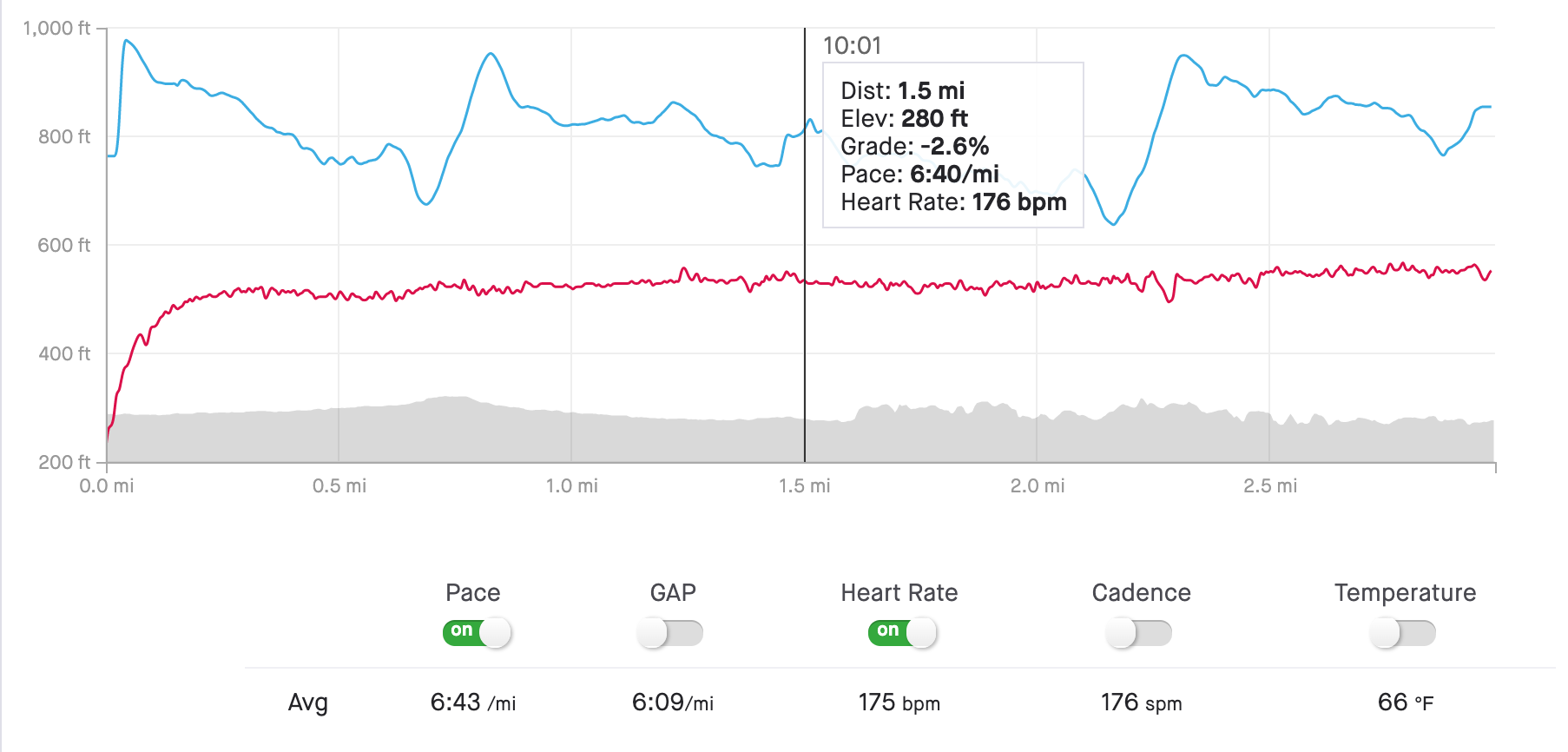 Hi Coaches,
My last 10 min average heart rate(175 bpm) of the run test is about 95% of my max heart rate, which is 184 estimated by Garmin watch and not tested in the lab. However, the LT heart rate is 165 estimated by the same Garmin watch.
I used to assume that 95% of the max heart rate is in my Vo2 max heart rate range. I felt it was hard during the final 10 min but somewhat manageable. My average heart rate for a 10-mile race finished under 1 hour 8 minutes 5 years ago was about 165-170 bpm.
My question is should I just use 175 bpm as my current LT heart rate? In this case, I think I just underestimate my LT heart for the past few years.
Thanks!
-

Hey, a couple questions.
1) Can you share some info on why we only take the average pace for the last 10 minutes of the run test vs. 95% of the entire 20' effort?
It just seemed a bit unrealistic to me when I plugged it in for my training zones. Definitely still on board for using the final 10' for the HR, considering the natural lag time - this is solely about the pace.
2) Is there a way to use the HR data from the run test to estimate heart rate training zones for the bike? (e.g., 10 bpm less than run LTHR)
I vaguely recall coming across some literature that discussed this, I just don't remember exactly what it said/ how to do it, or what your recommendation might be since the Ramp Test does not estimate HR.
Thanks!
-
Juanma Teixidó I would say go with the lab test - but remember that as you train and improve your speed will obviously get faster, but those HR zones are more evergreen. That being said, ambient conditions can affect heart rate a lot. Example: I was tested in a lab and my "sweet spot" FTP heart rate zone is 158-162. When it was freezing here (in Colorado) and I ran outdoors my HR was always low, but as we heat up here in the spring and summer my HR spikes and I have to be very careful not to stray from my heart rate zone in these conditions.
So in conclusion - Use the lab test but realize that colder/hotter conditions can affect your heart rate quite a bit. Exceeding the HR limits will cause significantly greater recovery time after harder runs in hot conditions. A lot of data to juggle!
-

Tony,
Thanks for the question. My first question to you, is the heart rate data from the chest strap or wrist. I have found the wrist to be spotty at best. From the the data you provided I have a few more questions. What is your last name? We will look at your data a little closer. How old are you? Did you stay in Z4 or were you going all out.
The quick answer is go with the lower number of 165. 175 is quite high. Some people do have higher heart rates, but for endurance building it will not be harmful to do a lot more work at a lower threshold. Plenty of time and intervals to push.
Scott, PPF Coach
-
Dominik,
1) This is a good question. The main reason is pacing. Most people go out too hot. Only looking at the back end of the interval tend to produce flush out the spikes early and give a consistent pace. However if you are someone who is very good at pacing and didn't not go out too hard and fast then using the 20' can work.
2) As far as computing bike heart rate zones for the run, you can use that 10 BPM lower as a general, but it is always good to get your own zones as specific as you can. It can be 15 BPM lower and it may be only 7. Clearly there are other variables like temp and humidity as well.
Hope this helps.
Scott, PPF Coach.
-
Coach Scott,
I use a chest strap heart rate monitor.
My last name is Kung and is 38. I felt the last 10 minutes might beyond z4. The RPE is about 9-9.5 / 10.
Currently, I train with Stryd and as a result use run power as my main effort reference as well as RPE. For the assessment, I did find my power was in the ballpark of z4 in terms of the power zone.
Is it possible that my z4 heart rate has been raised due to the last couple of years of training? I felt the last 10 minutes was hard but still sustainable.
-
Christian Santa cru 9,350 feet - that's high, even for Mexico City! If you did your test at that altitude and in the location that you usually train then those numbers are accurate. Most races will happen at sea level, though, so on race day your cycling power and swim/run pace numbers won't be accurate anymore. You would have to rely on heart rate and RPE in this case. OR re-test at sea level at some point (if that's feasible).
There are a lot of factors that go into training at that altitude (you're on the high end of what is considered "high altitude" - 2k to 3k meters). There are some articles in the Education Hub about training at altitude you should look into. My thoughts on this are not to tell you to stay on the low or high side of your FTP during training, but rather to consider other factors like hydration, recovery, sleep, and other things that are adversely affected when you train at high altitudes.
-
Tony,
Thanks for the information. Lets start at the bottom. Absolutey your LT will go up with long term consistent training. Nice work. Based off the information you have provided, I would split the different at go 170 for your LT. I think it is good that you use RPE as a primary metric. I would continue to do that.
Scott, PPF Coach

Post is closed for comments.
Comments
44 comments